

An owner statement is more than a payout notice. It summarizes rental income, expenses, and net earnings for a defined reporting period, showing how fees and other charges affect the amount available to you. Understanding my owner statement starts with tracing those entries from rent received to the final payout.
It’s natural to focus first on the amount deposited in your account. The statement puts that figure in context: management fees, maintenance costs, operating expenses, and funds held in reserve can all affect the distribution. This guide explains the main sections, how to read income and expense entries, and why a payout may differ from net income. Reviewing statements over time can also help you spot patterns and make informed decisions about your rental property.
Key Takeaways
- Start with the property details and reporting dates so you know exactly which account and period the statement covers.
- Follow income, management fees, expenses, and reserves to understand how the available payout is calculated.
- Compare statements over time to spot changes in costs, rent collected, or property performance.
- Keep statements and supporting records organized to make financial reviews and tax preparation easier.
What Is the Owner’s Statement for a Rental Property?
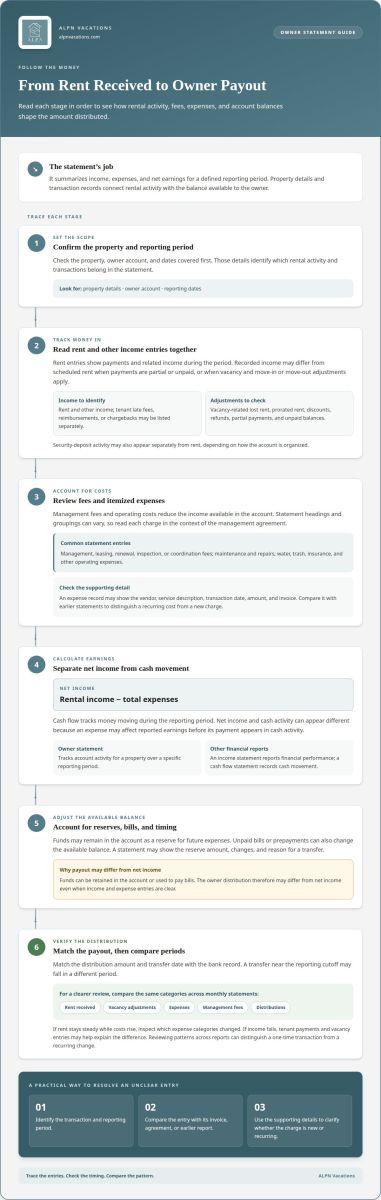
A rental property owner statement summarizes income, expenses, and net earnings for a defined period. Property details and transaction records connect rental activity with the balance available to the owner.
Property Details and Statement Line Items
Property details identify the rental, owner account, and reporting dates covered. Common entries include rent and other income, management fees, maintenance, operating expenses, and owner payout. These labels distinguish money earned from charges paid or retained. Water, trash, insurance, and repairs, for example, may appear as separate expenses rather than one combined amount.
Rent Payments, Vacancies, and Prorated Rent
Rent entries record payments and related income during the statement period, while vacancy and move-in or move-out adjustments can affect the total. Partial payments or unpaid balances may explain why recorded rent is below the lease amount. Prorated rent, discounts, refunds, and vacancy-related lost rent may also appear separately. Read these entries together to understand why scheduled rent and recorded income differ.
Itemized Expenses and Supporting Invoices
Expense entries show what was paid, when, and for which service or repair. Maintenance records can include a vendor, service description, transaction date, amount, and supporting invoice. Reviewing these details against historical statements helps distinguish a recurring cost from a new charge. According to the Internal Revenue Service, Form 1099-MISC reporting applies to rent payments of at least $600. The Internal Revenue Service also states reporting is required for at least $2,000 in rents (box 1).
Income, Expenses, and Cash Flow
Net income is rental income minus total expenses; cash flow tracks money moving during the reporting period. A payout may differ from net income if funds remain in the account or are used to pay bills. Compare each monthly owner statement with previous records to spot changes in rent collected, vacancy, or maintenance costs. Repeated charges for the same repair, for example, may indicate an ongoing property issue worth examining.
Financial clarity and informed decision-making
Understanding my owner statement means looking beyond a single payout to see what changed and why. Comparing monthly reports can help distinguish a one-time transaction from a shift that may affect property decisions.
Owner Statements and Financial Statements
An owner statement tracks account activity for a property over a specific reporting period. An income statement organizes income and expenses to report financial performance, while a cash flow statement records cash movement. Each serves a different purpose. For example, an expense may affect reported earnings before its payment appears in cash activity. Check each report’s dates and scope to understand apparent differences.
To reconcile a statement with a bank deposit, match the distribution amount and transfer date with the bank record. A transfer near the reporting cutoff may fall in a different period. For year-end tax forms, compare reported amounts with your rental records and note any credits, adjustments, or timing differences that need explanation.
Owner Portals and Financial Visibility
An owner portal can make reports and property account activity easier to access in one place. Review transaction descriptions and dates to connect report entries with transfers or expenses. Supporting invoices can clarify charges, while archived reports help you track account changes over time.
For a useful performance comparison, review the same categories across monthly reports: rent received, vacancy adjustments, expenses, management fees, and distributions. If rent stays steady while costs rise, investigate which expense categories changed. If income falls, tenant payments and vacancy entries may explain the difference. Understanding my owner statement also means looking at these patterns together rather than drawing conclusions from one month alone.
When a transaction remains unclear, identify the reporting period and entry, then ask the property manager for supporting details. Comparing that explanation with the invoice or prior report can help clarify whether the charge is new or recurring. This record-based approach supports informed decisions about property operations. For ongoing help with rental operations and reporting, explore vacation rental management services.
Property management fees
Management fees and account adjustments affect how rental income becomes an owner distribution. Statement headings and groupings may vary by property manager, so interpret labels in the context of the management agreement.
A fee entry may describe monthly management, leasing, renewal, inspection, or coordination charges. The management agreement explains which provisions apply and how each charge is determined. If an entry is unclear, compare its description with the agreement and earlier records, then ask the property manager for the relevant provision or a detailed transaction report.
Account balances also affect the payout. A property manager may retain a reserve for future expenses, while unpaid bills or prepayments can change the available balance. A statement may show the reserve amount, changes, and reason for a transfer. The owner distribution can therefore differ from net income even when the income and expense entries are clear.
Tenant charges, such as late fees, reimbursements, or chargebacks, may appear as separate income entries. Security-deposit activity may also be recorded separately from rent, depending on how the account is organized. State rules may affect reporting obligations, and the property manager determines the statement’s labels and groupings.
For rental property owners, statements help assess performance, but they don’t show every part of return on investment. Compare rental income and operating costs across reporting periods, then consider net operating income alongside the property’s investment costs. This can help reveal whether rising expenses or vacancy, rather than management fees alone, are affecting results.
For a specific fee or account adjustment, note the transaction, reporting period, and relevant provision in the management agreement when contacting the property manager. Ask for supporting details if the entry remains unclear. An explanation and invoice can connect the charge to the property record and clarify its effect on the available balance.
Owner statement formats can vary by property manager, and applicable fees depend on the management agreement. State rules may affect reporting obligations.
Owner statement definition and purpose
An owner statement records a rental property’s financial activity and account position for a set period. Understanding my owner statement means treating it as an operating document, not a complete valuation of the investment. It brings recorded transactions together so owners can see how rental operations affect funds held or distributed. The reporting dates define which activity appears in that snapshot.
The statement also provides a reference point for conversations about property operations. Property managers may use different labels, so focus on transaction descriptions and the reporting period. A seasonal income change, for example, may reflect booking patterns, while a rise in a particular expense category may point to changed services or maintenance needs.
Balances connect one reporting period to the next. The opening balance shows the account’s starting position; the closing balance reflects activity recorded during that period. If funds are held in reserve, the balance may include money that is not available for immediate distribution. Keeping reserve and payable amounts distinct helps clarify what the account holds and what has moved.
Over time, statements can reveal operational trends that a single report cannot. Compare the same categories across periods, then consider whether changes in income or costs are recurring. For owners focused on understanding my owner statement, the key is how recorded activity connects to the property’s cash position, not simply whether one month’s payout is higher or lower.
That perspective can guide conversations about property operations and future priorities. If you’re considering support with rental management and its related records, explore vacation rental management services.
ALPN Vacations
ALPN Vacations provides tailored vacation rental management services for owners seeking support with their property’s operations. Once you master the process of understanding my owner statement, professional management may be a natural next step if you’re considering how rental activity is handled and reported. Clear records help make income, expenses, and account movement easier to understand; management connects that financial picture with the ongoing work of a vacation rental.
ALPN Vacations also offers stays at Amphitheater Haus, Ouray Main Street Luxury Penthouse, and The Ouray Nook. If you’re weighing management support alongside your statement figures, contact ALPN Vacations to discuss your property.
Make your next property decision with clarity
Rental property records can do more than document past activity. Reviewed consistently, they can help you prepare for maintenance, consider operational changes, and have focused conversations about property management. Understanding my owner statement can turn routine review into a habit that informs decisions throughout the year, rather than a task reserved for tax season.
If you’re considering management support for a vacation rental, ALPN Vacations offers Vacation Rental Management Services, as well as stays at Alpenglow Cabin – Rustic Mountain Retreat, Amphitheater Haus, and Ouray Main Street Luxury Penthouse. The right next step depends on what you want managed and how hands-on you prefer to be.
Bring your questions and property goals into the conversation, then explore whether a management relationship fits your plans. Contact ALPN Vacations to discuss your next step. A calm, informed approach can help you move forward with greater confidence.
Frequently Asked Questions
Questions about your statement?
Start by noting the property, reporting dates, and exact entry you want explained. Include the transaction date and amount, then compare the entry with its supporting record or management agreement. For an Ouray rental, this context can keep the question focused on a specific charge or transfer. Ask the property manager to clarify the entry and provide related details.
Are Expenses Itemized Clearly?
An expense is easier to understand when it can be tied to a specific transaction. A line labeled “maintenance,” for example, may need more detail to distinguish a repair visit from a replacement part. Look for the vendor, service description, date, and amount. If one entry covers several tasks, an invoice or transaction report can show what the charge represents.
Are Property Management Fees Easy to Identify?
Fee entries are easier to recognize when labeled by purpose, such as management, leasing, or inspection. Wording may differ between reports, so compare the entry with the relevant agreement provision. If a charge appears under a broad category, ask which service or clause it relates to. This can clarify whether it’s a new fee or a familiar charge under a different label.
Does It Clearly Show the Owner Distribution?
A useful statement identifies the amount distributed to the owner and the transfer date, distinguishing a payout from funds remaining in the property account. If the bank deposit differs, compare its date and amount with the recorded distribution. A transfer near the reporting cutoff may appear in a different period, so align the dates before treating the difference as an error.
Does It Show the Beginning Balance?
Yes. The beginning balance records the amount carried into the statement period. Compare it with the previous period’s ending balance and note any payout or adjustment recorded between those dates. A transfer after one report closed, for example, may affect the next opening figure. Matching the two balances establishes a clear starting point before you review the period’s activity.
Does the Ending Balance Make Sense?
The ending balance should reconcile with the starting balance and the activity recorded during the reporting period. Review income, expenses, transfers, and retained funds, checking transaction dates and whether amounts are credits or deductions. If the result still seems inconsistent, identify the first entry that doesn’t match your records. A focused review makes it easier to find the source of the difference.